
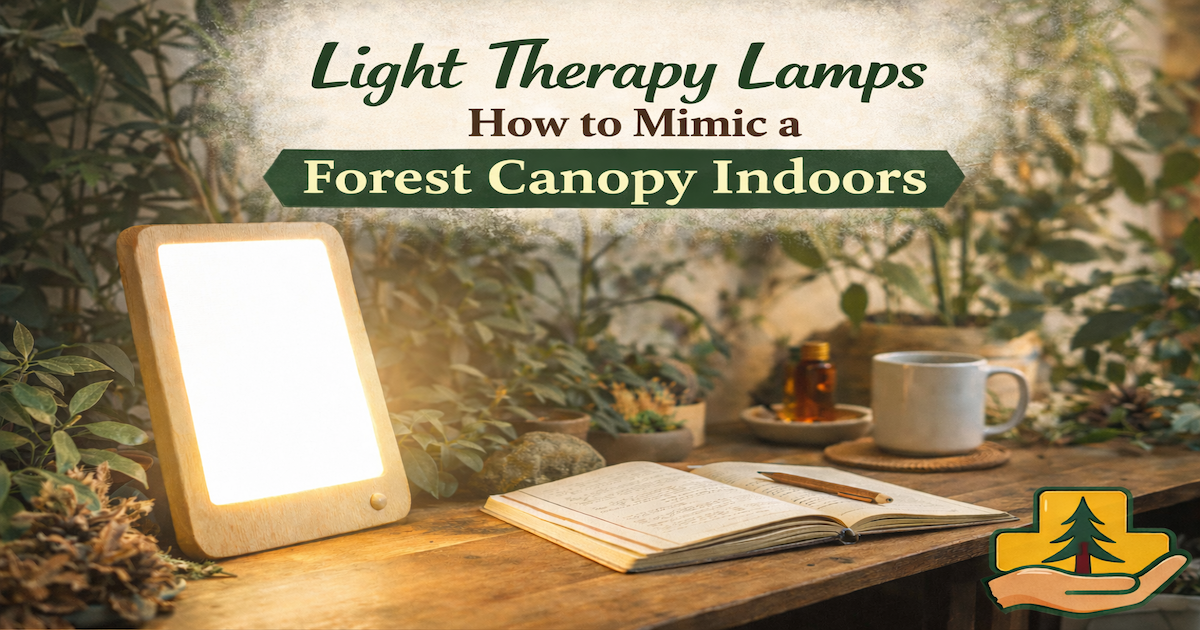
When winter arrives, the forest canopy thins and daylight reaches the ground more easily. Indoors, the opposite often happens: our spaces get dimmer, we spend more time under weak overhead lighting, and our bodies get fewer “daytime” signals.
Light therapy lamps can help you recreate a brighter, more natural rhythm, especially in the darker months, when used correctly and consistently. (If you’re buying one for SAD or winter low mood, prioritize 10,000 lux and UV-freelight.)
This guide shows you how to choose a lamp, use it safely, and set it up to feel more like dappled forest light than a clinical light box.
Contents
- 1 Why forest light matters
- 2 What are light therapy lamps?
- 3 Quick-start protocol (the simplest routine that works)
- 4 How to choose a forest-inspired lamp (buyer checklist)
- 5 Recommended light therapy lamps (UK + US)
- 6 How to mimic forest light in daily practice (without wrecking your sleep)
- 7 Build a “forest canopy” setup (make it feel like dappled light)
- 8
- 9 Enhancing the experience: forest therapy add-ons
- 10 When to use caution (read this)
- 11 FAQ
- 12 Forest wisdom meets modern science
Why forest light matters
In a healthy forest, sunlight filters through leaves and shifts constantly across the day. That changing pattern helps regulate natural rhythms in plants, animals, and humans.
Humans evolved under strong outdoor light in the morning and dimmer light at night. In winter (and indoor-heavy living), that pattern can get scrambled, often showing up as low mood, poor sleep, fatigue, or a “flat” feeling.
A light therapy lamp is basically a way to restore a stronger morning light cue when outdoor daylight is limited.
What are light therapy lamps?
Light therapy lamps (also called light boxes or SAD lamps) deliver bright light designed to mimic outdoor daylight. Typical guidance for SAD-style light therapy is:
-
Brightness: aim for 10,000 lux
-
Timing: morning, ideally within the first hour after waking
-
Duration: often 20–30 minutes daily (follow the device instructions)
-
Placement: usually 1–2 feet away, eyes open, don’t stare directly at the light
For UK readers: the NHS advises ensuring your lamp is 10,000 lux, UV-free, and has a UKCA or CE mark.
Quick-start protocol (the simplest routine that works)
If you only do one thing, do this:
-
Use the lamp in the morning (within ~1 hour of waking)
-
20–30 minutes at the distance stated for 10,000 lux
-
Lamp slightly to the side of your face while you read, journal, eat breakfast, or plan the day
Consistency beats intensity. A smaller daily habit tends to work better than occasional long sessions.
How to choose a forest-inspired lamp (buyer checklist)
Most “light therapy” confusion comes from missing specs.
Here’s what actually matters:
Non-negotiables
-
10,000 lux at a stated distance (not “equivalent” brightness)
-
UV-free / minimal UV output
-
Flicker-free / low flicker (comfort + headache reduction for many people)
-
Large enough light surface to feel natural (bigger panels usually feel more “daylight-like”)
Nice to have
-
Timer (so you don’t overdo it)
-
Multiple brightness levels
-
Adjustable angle/stand
-
A diffuser / low-glare surface (more canopy, less “spotlight”)
“Forest feel” (optional, but aligned with your theme)
-
Soft edges, warm materials, wood tones, or a calm form factor that invites daily use (because the best lamp is the one you’ll actually use).
Recommended light therapy lamps (UK + US)
Below are reputable options that hit the core specs. Always confirm the lux distance, UV rating, and certification where relevant.
UK recommendations (clearly UK-friendly brands/options)
Best all-around (large panel): Lumie Brazil (10,000 lux)
A well-known UK brand with a large surface area that feels less “clinical.”
Best compact/slim: Lumie Vitamin L (10,000 lux at close range)
Great if you want a smaller footprint and still want true SAD-lamp specs.
Alternative (widely stocked in UK/EU): Beurer daylight therapy lamps
Beurer has multiple models in the category; choose the one that clearly states 10,000 lux at X distance and is UV-safe.
UK safety note: The NHS recommends checking for 10,000 lux, UV-free, and UKCA/CE marking before buying.
US recommendations (high-spec, widely recommended models)
Best overall (large screen): Carex Day-Light Classic Plus
Known for a large light surface, which can feel more natural and “room-like.”
Best customizable desk option: Verilux HappyLight Luxe (10,000 lux, UV-free)
Adjustable settings and a compact form factor that’s easy to keep on a desk.
Best high-output classic light box: Northern Light Technologies BOXelite
A long-running, spec-forward option with published dimensions and power details.
High-brightness alternative: Alaska Northern Lights NorthStar
A bigger, stronger unit that’s often used at farther distances; confirm your preferred distance and comfort.
How to mimic forest light in daily practice (without wrecking your sleep)
1) Morning exposure (20–30 minutes)
Place the lamp slightly to the side, like light coming through trees, while you do something quiet (tea, journaling, planning).
2) Midday “clearing” boost (optional, 10–15 minutes)
If you slump midday, a shorter session can help. Keep it earlier rather than late afternoon.
3) Evening wind-down (no bright/blue daylight lamp after ~6pm)
This is where people accidentally sabotage sleep: bright light late in the day can shift your rhythm in the wrong direction. Morning is the sweet spot.
Build a “forest canopy” setup (make it feel like dappled light)
This is the part most SAD lamp guides miss: how it feels affects whether you’ll do it daily.
Try this simple setup:
-
Put the lamp slightly behind or beside your monitor (not dead-on like a spotlight)
-
Add a plant with leaves between you and part of the lamp (creates soft shadow edges)
-
Use a light surface nearby (a pale wall or desk mat) to bounce light like a forest clearing
-
Keep your morning area tidy and natural: wood, stone, paper textures
You’re aiming for bright + softened,not harsh glare.
Enhancing the experience: forest therapy add-ons
To deepen the “forest cue,” stack gentle sensory signals:
-
Forest soundscapes (rain, wind, birds)
-
Cedar/pine essential oils (if you tolerate fragrance)
-
A small piece of wood/moss/stone texture on your desk
-
A short “forest breath” ritual: 10 slow breaths while the lamp warms up
When to use caution (read this)
Light therapy is generally well-tolerated, but it’s not for everyone.
-
Avoid using your bright therapy lamp late day/evening (sleep disruption risk)
-
Don’t stare directly at the light; keep it angled and to the side
-
If you have bipolar disorder, a history of mania/hypomania, significant eye conditions, or strong light sensitivity, talk to a clinician first
-
Follow your specific device’s instructions for distance and duration.
If your symptoms are severe or persistent, treat a lamp as support, not as the whole plan.
FAQ
How bright should light therapy lamps be?
Most clinical guidance centers on 10,000 lux at a specified distance.
How long should I use it each day?
Common recommendations are 20–30 minutes in the morning, ideally within the first hour after waking.
How far away should the lamp be?
Many protocols place the light about 1–2 feet from your face, but always follow the manufacturer distance for 10,000 lux.
Can I use a SAD lamp at night?
Not recommended for most people—late bright light can interfere with sleep and circadian timing. Morning use is typical.
What should I look for in the UK?
The NHS advises: 10,000 lux, UV-free, and UKCA/CE marking.
Will blue light work better than white light?
Most mainstream guidance focuses on bright, UV-minimized light at proper timing/dose rather than “more blue.” If you’re unsure, stick to established SAD-lamp specs and morning use.
Forest wisdom meets modern science
Light Therapy lamps are modern tools that supports an ancient truth: we’re creatures of light and rhythm. In winter, let your lamp be a surrogate morning sun. In spring, start swapping sessions for real outdoor morning light when possible.
If you want the “forest canopy” feeling, focus less on perfection and more on repeatability: a calm corner, softened bright light, a few living textures, and a simple daily ritual. Small signals, done consistently, add up.
