
Contents
- 1 Fast Answer
- 2 What is shinrin-yoku?
- 3 What is forest therapy?
- 4 How are forest therapy and shinrin-yoku similar?
- 5 What are the main differences between forest therapy and shinrin-yoku?
- 6 Why does the cultural context matter?
- 7 How do the experiences feel different in practice?
- 8 Which is better for beginners?
- 9 How do you choose between forest therapy and shinrin-yoku?
- 10 What are the benefits and limits of each approach?
- 11 What would this look like in a real-world example?
- 12 What mistakes do people make when comparing the two?
- 13 FAQ
- 14 Author
Fast Answer
Forest therapy vs shinrin-yoku is mostly a question of scope, culture, and structure. Shinrin-yoku is the Japanese origin practice. Forest therapy is the broader field that grew around it and now includes guided frameworks, reflection, and adaptations across cultures. Both use slow, sensory time in nature. They differ in how much structure, facilitation, and interpretation they bring into the experience.
What is shinrin-yoku?
Shinrin-yoku is usually translated as “forest bathing.” It emerged in Japan in 1982 as a formal practice linked to public health, stress relief, and reconnection with nature. Its core idea is simple: take in the forest atmosphere through the senses rather than treat the forest as a place for exercise, achievement, or productivity.
In shinrin-yoku, the forest is not a backdrop. It is the experience itself. The emphasis is on slowness, presence, and sensory awareness. Participants are invited to notice scent, texture, light, sound, air, and mood, often with minimal talking and minimal agenda.
Its roots also matter. Training material in your library describes shinrin-yoku as shaped by Japanese cultural attitudes toward nature, including Shinto and Buddhist influences that emphasize harmony, reverence, and interconnectedness. That cultural layer helps explain why shinrin-yoku often feels gentle, contemplative, and non-instrumental.
What is forest therapy?
Forest therapy is the broader modern practice of guided nature connection in forested or nature-rich settings. It shares many principles with shinrin-yoku, but it is often more explicitly structured and more widely adapted outside Japan. It may include guided invitations, sit spots, group sharing, closing rituals, and integration practices that help people carry the experience into daily life.
In many Western contexts, forest therapy has drawn from ecopsychology, outdoor education, mindfulness, and wellness practice. That does not make it better or worse than shinrin-yoku. It makes it broader and, in some settings, more framework-driven.
A typical forest therapy session may include:
- an arrival or threshold moment
- a sequence of sensory invitations
- slow walking
- a sit spot
- optional group sharing
- a tea or closing ritual
- reflection and integration afterwards
Those elements create a reliable container. They help guides work with beginners, groups, busy professionals, or people who struggle to slow down on their own.
How are forest therapy and shinrin-yoku similar?
They are more alike than different. Both value slowing down. Both emphasize sensory awareness. Both use forest environments to support a shift away from overstimulation and toward presence. Both are associated with stress reduction, mood support, and a felt sense of reconnection with the more-than-human world.
They also share several operating principles:
- mindfulness in nature
- multisensory attention
- intentional slowness
- less focus on achievement
- a respectful relationship with place
- openness to silence and quiet observation
These themes run through both traditions, even when the language differs.
This is why many people use the terms loosely in everyday conversation. In casual use, someone may say “I do shinrin-yoku” when they mean guided forest therapy, or “I offer forest therapy” when the session is strongly inspired by Japanese forest bathing. The overlap is real. The distinction becomes clearer when you look at roots, facilitation style, and session design.
What are the main differences between forest therapy and shinrin-yoku?
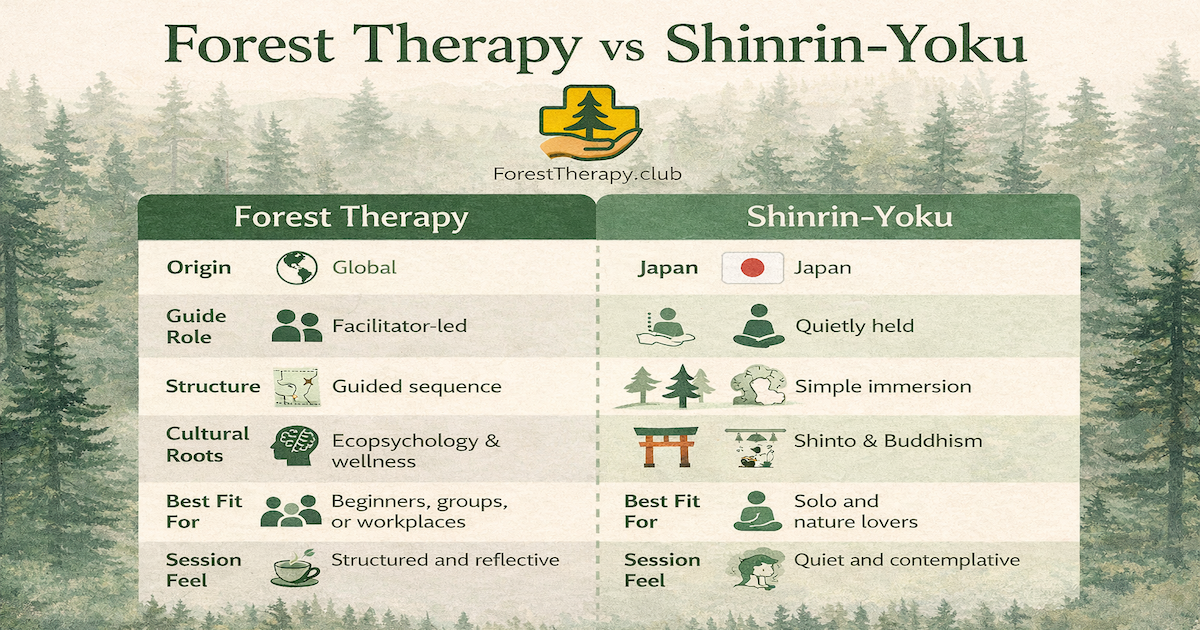
The clearest way to compare them is through a four-part framework: origin, intention, structure, and guide role.
1. Origin
Shinrin-yoku began in Japan as a named practice in the early 1980s. Forest therapy is the wider field that expanded globally as nature-based wellbeing work evolved.
2. Intention
Shinrin-yoku tends to emphasize being with the forest. Forest therapy often emphasizes both being with the forest and supporting a guided process of restoration, reflection, or integration.
3. Structure
Shinrin-yoku is often lighter-touch and less directive. Forest therapy often uses a clearer session arc with invitations, pauses, solo time, and closing practices.
4. Guide role
In shinrin-yoku, the guide often holds a contemplative atmosphere and gives minimal instruction. In forest therapy, the guide may take a more active role by offering prompts, facilitating group sharing, adapting for participants, and shaping the overall flow.
That difference in guide role is often what participants feel most strongly. One experience may feel like permission to simply notice. The other may feel like a carefully crafted sequence that helps attention deepen step by step.
Why does the cultural context matter?
The difference is not only technical. It is cultural. Shinrin-yoku grew from Japanese ways of relating to nature, including traditions that frame forests as meaningful, sacred, and relational. Forest therapy, especially in Western settings, often reflects values such as structure, clarity, measurable outcomes, and adaptation across populations.
That matters for two reasons.
First, it prevents flattening the origin story. Shinrin-yoku is not just a trendy synonym for “walking in the woods.” It is a specific practice with a specific cultural birthplace.
Second, it helps guides work respectfully. Your training materials note that integrating Eastern and Western approaches can be useful, but only when practitioners study both traditions carefully and avoid oversimplification or appropriation.
A strong evergreen rule is this: honor the roots, explain the differences plainly, and adapt with care.
How do the experiences feel different in practice?
In practice, shinrin-yoku often feels quieter, lighter, and less managed. You may spend long stretches walking slowly, breathing, noticing scent, or sitting without needing to “process” much. The atmosphere matters as much as the method.
Forest therapy often feels more intentionally held. A guide may offer invitations such as:
- notice three textures without naming them
- follow what your feet want to do at a slower pace
- sit with one tree for ten minutes
- share one image or phrase that stayed with you
That structure can help many people, especially beginners, enter a restorative state more easily. It can also support groups, workplaces, and mixed-ability participants because the experience has a clearer container.
Neither approach is inherently deeper. They simply open the door in different ways.
Which is better for beginners?
For most beginners, forest therapy is often easier to access because the structure reduces uncertainty. Many people arrive overstimulated, distracted, or unsure what they are “supposed” to do in nature. Invitations, pacing, and closing rituals help them settle.
However, some people respond better to the simplicity of shinrin-yoku. They do not want a lot of explanation. They want permission to breathe, wander slowly, and stop treating nature as another task. For that person, shinrin-yoku may feel more spacious and less performative.
A practical decision rule looks like this:
- choose shinrin-yoku if you want less talking and more direct sensory immersion
- choose forest therapy if you want a guide-held sequence and clearer invitations
- choose an integrated approach if you want both contemplative depth and supportive structure
That middle path is increasingly common in modern practice.
How do you choose between forest therapy and shinrin-yoku?
Use this four-question filter.
Do you want simplicity or structure?
Shinrin-yoku leans simple. Forest therapy leans structured.
Do you want solo contemplation or guided reflection?
Shinrin-yoku often gives more space for quiet individual experience. Forest therapy more often includes facilitated invitations and optional group sharing.
Do you want cultural fidelity or local adaptation?
If you are specifically seeking the Japanese tradition, look for shinrin-yoku grounded in that lineage. If you want a locally adapted practice for a specific group or context, forest therapy may be the better fit.
Do you want atmosphere or framework?
Both have atmosphere. Forest therapy usually adds more framework. Shinrin-yoku usually preserves more spaciousness.
What are the benefits and limits of each approach?
Both approaches may help people reduce stress, slow rumination, and feel more connected to nature. Your training library also links forest environments with outcomes such as cortisol shifts, heart rate variability support, mood improvement, and cognitive restoration, while also noting the importance of careful interpretation and evidence-based language.
Still, both have limits.
They are not substitutes for medical care. They are not crisis interventions. They are also not ideal when someone expects a quick fix after one walk. Nature connection is powerful, but it usually works best as a repeated practice rather than a one-time performance.
There are also practical constraints:
- access to suitable green space
- weather and mobility needs
- group fit and facilitation quality
- cultural sensitivity
- participant expectations
A well-led session acknowledges those realities instead of pretending every forest walk works the same for every person.
What would this look like in a real-world example?
Imagine two stressed founders.
Founder A is tired of constant input and wants silence. They do not want to talk much. They want to move slowly, smell cedar, notice wind in the canopy, and leave with more space in their nervous system. Shinrin-yoku may be the better fit.
Founder B also feels stressed, but struggles to slow down alone. They benefit from being guided into attention. A forest therapy session with invitations, a sit spot, and a clear closing may help them arrive more fully and actually stay present long enough to feel the shift.
This is also how ForestTherapy.club can approach the distinction: not as a fight over labels, but as a choice of container. The question is not which term sounds nicer. The question is which form best supports the person, place, and purpose.
What mistakes do people make when comparing the two?
The first mistake is assuming they are completely different. They are not. They share core principles and overlapping practices.
The second mistake is assuming they are exactly the same. They are not. The cultural roots, facilitator role, and level of structure differ in important ways.
The third mistake is treating shinrin-yoku as a branding term rather than a tradition. That strips away its context.
The fourth mistake is treating forest therapy as therapy in the clinical sense. In most wellness contexts, it is better understood as a guided nature-based practice that may support well-being, not a replacement for licensed mental health care. This distinction protects both participants and guides.
FAQ
Is shinrin-yoku the same as forest bathing?
Yes. Shinrin-yoku is the Japanese term most often translated as “forest bathing.” It refers to taking in the forest atmosphere through the senses, not bathing in water.
Is forest therapy just another name for shinrin-yoku?
Sometimes people use them interchangeably, but they are not exact synonyms. Shinrin-yoku is the Japanese origin practice, while forest therapy is the wider modern field that often includes more guided structure and local adaptation.
Does forest therapy always require a guide?
No, but guided sessions are common. Training materials describe forest therapy as often including invitations, sit spots, sharing, and integration, which are easier for many people to access with a trained facilitator.
Can shinrin-yoku happen outside Japan?
Yes, but respectful adaptation matters. Your source materials note that practitioners should honor the cultural roots of shinrin-yoku while adapting practices thoughtfully to local ecosystems and communities.
Which is better for stress reduction?
Both may help. The better option is usually the one you will actually practice and the one that matches your temperament. Some people need minimal instruction. Others need more guidance and structure.
Can I combine both approaches?
Yes, and many modern practitioners do. An integrated approach can preserve the sensory and contemplative depth of shinrin-yoku while using the supportive sequencing of forest therapy.
Decision Rule: Forest Therapy vs Shinrin-Yoku
Choose shinrin-yoku if you want a quiet, sensory, low-instruction immersion rooted in the Japanese tradition of forest bathing.
Choose forest therapy if you want a guided, structured, framework-led experience with invitations, reflection, and integration.
Choose an integrated approach if you want both contemplative depth and a supportive session container.
Bring the grounding spirit of shinrin-yoku indoors with the Winter Nature-Led Home Reset.
Transform your living space with the Winter Nature-Led Home Reset and create a winter sanctuary for calm, focus, and renewal. Discover how the spaces you inhabit reflect and shape your inner world. Together, we’ll gently reimagine your home, office, or creative corner through nature connection, sensory awareness, and intuitive design, so your environment supports more presence, rooted beauty, and everyday ease.
Author
I’m Dominik Boecker, the founder of Forest Therapy Club, where I help people reconnect with nature through grounded, well-structured forest experiences. I explore shinrin-yoku, forest therapy, nervous system regulation, mindful leadership, and sustainable ways to slow down in a fast-moving world. I focus on practical, ethical guidance that helps readers and clients build a deeper relationship with the natural world, without hype or health claims.
