
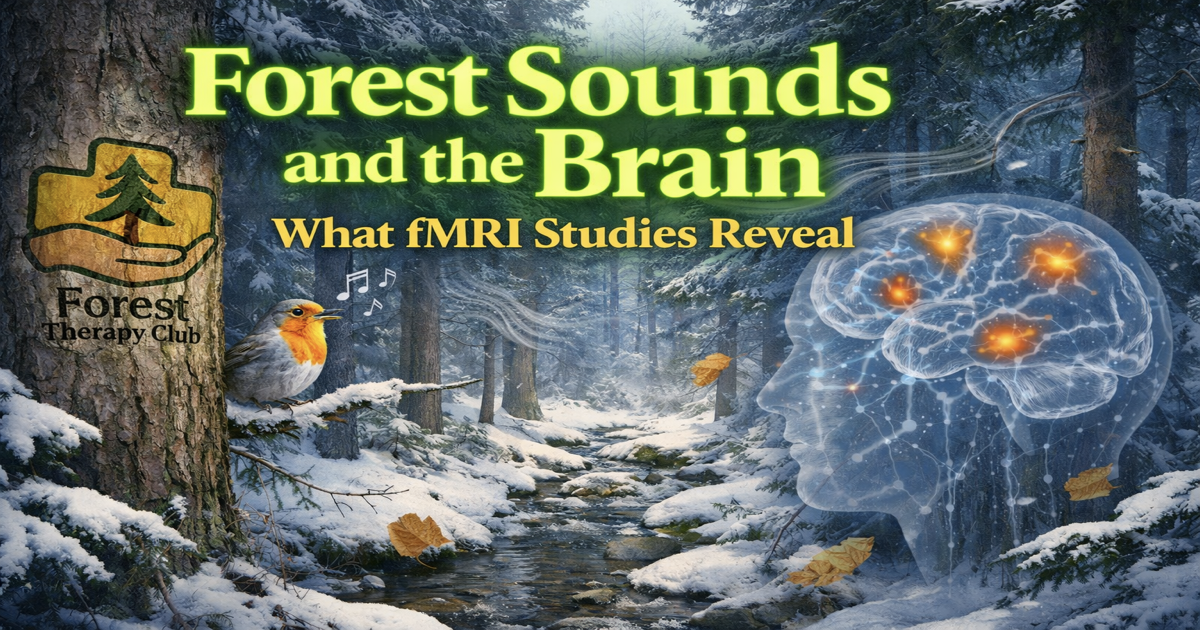
Forest sounds and the brain are closely connected, with research showing that natural soundscapes may reduce activity in the amygdala (linked to stress) and enhance default mode network activity (associated with calm, reflective states). fMRI evidence suggests these sounds activate regions involved in emotion regulation, sensory integration, and attention restoration, helping explain why forest therapy often supports mental clarity and relaxation.
Why This Matters
- Bridges practice with neuroscience. fMRI studies give legitimacy to forest therapy’s calming effects.
- Guides session design. Guides can prioritize sound-focused invitations based on evidence.
- Validates sensory impact. Sound is a measurable vector of nature’s effect on the nervous system.
- Supports trauma-sensitive work. Auditory cues can offer gentle entry points for those with visual or physical overstimulation concerns.
- Informs urban adaptations. Even recorded forest sounds show benefits, critical for city-based or virtual forest therapy.
How does the brain respond to forest sounds?
Functional MRI (fMRI) studies show that natural sounds, particularly forest soundscapes, lead to decreased activation in the amygdala, a key region involved in fear and stress responses. At the same time, these sounds increase connectivity in the default mode network (DMN), which is associated with introspection, emotional regulation, and a sense of calm.
What are “forest sounds”and the brain in research settings?
Most studies define “forest sounds” as a mix of birdsong, wind through leaves, water flowing, and rustling foliage. Unlike artificial soundscapes, these are typically unstructured and low-frequency, offering irregular but soft patterns that the brain perceives as non-threatening and soothing.
- Birdsong is particularly linked with attention restoration.
- Water and wind sounds support parasympathetic nervous system activation.
- Silence punctuated by nature sounds may offer the most potent relaxation effects.
What does fMRI actually measure?
Functional MRI doesn’t show thoughts, it measures changes in blood flow and oxygenation, which reflect neural activity.
In forest sound studies, this often includes:
- Reduced activity in the amygdala (stress)
- Increased activity in prefrontal areas (emotion regulation)
- Improved default mode network stability (self-awareness and rest)
- Lower salience network activity (less scanning for threats)
Does nature sound therapy work without a forest?
Yes. Research shows that even listening to recorded forest sounds indoors can yield measurable reductions in heart rate, anxiety, and negative rumination. This is particularly useful for:
- Urban forest therapy
- Workplace micro-practices
- Virtual or audio-only guided sessions
It’s not a replacement for full immersion, but a powerful tool when direct access is limited.
Common Mistakes
- Assuming all nature sounds are equal—white noise or artificial nature loops may lack the frequency variation needed for brain effects.
- Overlooking individual trauma triggers—certain bird calls or wind can cause distress depending on personal history.
- Ignoring the role of soundscape layering—overlapping urban or human-made noise reduces the positive effect.
- Not testing playback quality—poor audio fidelity can create more distraction than calm.
- Using sound as a substitute, not a supplement—it should enhance sensory engagement, not replace embodied experience.
FAQ
Can forest sounds and the brain help with anxiety?
Many people report reduced anxiety after listening to forest sounds. fMRI and physiological studies suggest this is due to reduced activation in brain regions linked to fear and threat processing.
How long do you need to listen to forest sounds to see effects?
Some studies report changes in brain activity and cortisol levels after as little as 10–20 minutes of exposure to natural soundscapes. Longer sessions may support deeper nervous system regulation.
Are live sounds better than recordings?
Yes—but only slightly. Live soundscapes carry more sensory coherence (sound, scent, temperature), but high-quality recordings can still activate key calming pathways, especially when used with mindful listening practices.
What’s the role of silence in forest therapy?
Silence between sounds, like the pause between bird calls or wind gusts, may be just as important as the sounds themselves. These pauses support parasympathetic activation and deepen the sense of spaciousness.
What equipment should guides use for sound therapy?
High-fidelity portable speakers, directional mics for live amplification, or noise-isolating headphones (for urban settings) are common. Quality and clarity are more important than volume.
The neuroscience behind forest sounds reveals what many people already feel: that nature’s auditory landscape offers more than just background noise. It’s a direct and measurable pathway to nervous system regulation, emotional calm, and mindful presence. Whether live or recorded, forest soundscapes deserve a central role in both research and practice.
Try a sound-focused forest therapy session or build your own listening ritual today.
