
Contents
Fast Answer
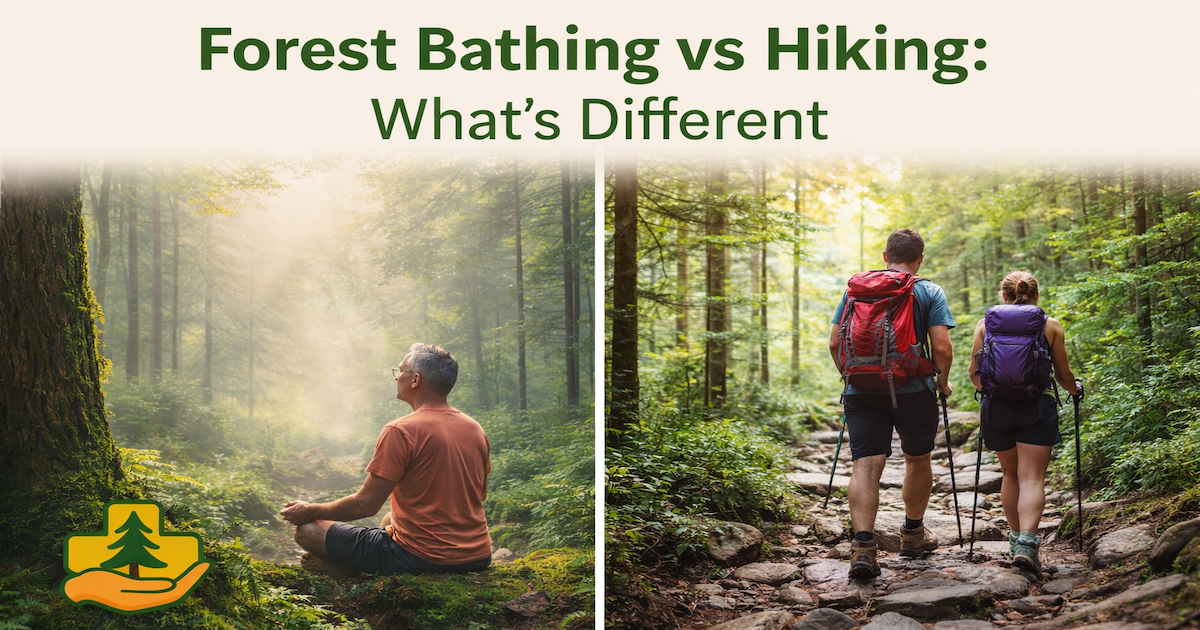
Forest bathing vs hiking offers two distinct but complementary ways to engage with nature. Forest bathing is a slow, sensory-driven immersion designed to cultivate mindfulness, drawing you fully into your surroundings through sight, sound, touch, smell, and even taste. Hiking, on the other hand, tends to be more purposeful physical movement across terrain, blending exercise with scenic exploration. While both can reduce stress, forest bathing emphasizes presence, grounding, and relaxation without exertion. Hiking delivers benefits through physical activity and exposure to nature, boosting mood and endurance. For Founder-CEOs facing chronic stress, understanding which approach fits your goals, whether immediate calm or enhanced fitness, can optimize both mental clarity and resilience.
Key Takeaways
- Forest bathing is about mindful, slow sensory engagement rather than exercise.
- Hiking combines physical exertion with nature exposure to improve fitness and mental health.
- Forest bathing works best for immediate stress relief through deep relaxation and presence.
- Hiking is ideal for those seeking physical activity alongside mental decompression but requires more effort and preparation.
- Both practices complement each other: use forest bathing to reset and hiking to build stamina.
- You can practice forest bathing anywhere there is greenery, not just in dense forests.
- Mindful presence and technological disconnection are key for both to maximize stress reduction.
Why This Works: forest bathing vs hiking
Forest bathing vs hiking addresses stress through distinct physiological and psychological mechanisms. Shinrin-yoku, or forest bathing, originated in Japan as a therapeutic practice to reduce cortisol, lower blood pressure, and engage the parasympathetic nervous system by tuning attention to natural sensory inputs. Every texture, scent, and sound acts as an anchor, fostering present-moment awareness that interrupts the habitual stress-response loop. This quiet, intentional receptivity helps Founder-CEOs pause racing thoughts and mentally “reset.” Contrastingly, hiking triggers endorphins and serotonin via cardiovascular activity, enhancing mood and physical vigor. The green environment adds restorative qualities to the exercise. Though both support well-being, forest bathing excels when you need to slow down mentally without physical strain, while hiking suits those aiming to add fitness and endurance gains alongside nature’s benefits.
Common Mistakes
1. Treating forest bathing like a hike, moving quickly and focusing on distance or pace rather than sensory presence.
2. Trying to multitask on a forest bathing walk, including checking phones or listening to podcasts, which dilutes mindfulness.
3. Over-scheduling hikes, making them feel like another to-do instead of restorative time.
4. Ignoring the finer sensory details during forest bathing; instead rely on conscious exploration of texture, smell, sound, and light.
5. Assuming forest bathing alone will improve physical fitness; it supports mental stress but lacks aerobic benefits.
6. Bringing technology that competes for attention during either practice.
7. Expecting only deep forest environments qualify for forest bathing—urban parks or gardens can work well.
8. Failing to warm up before hiking or pushing too hard without conditioning, leading to injury.
9. Neglecting proper gear, hydration, and weather awareness for hiking, which can turn stress relief into stress induction.
10. Confusing mental relaxation goals with intense cardio—know your objective before choosing the activity.
The 20-Minute Protocol
1. Choose a quiet, natural area: a forest, large park, or well-vegetated garden.
2. Turn off all electronic devices and fully commit to disconnecting during the experience.
3. Stand or sit comfortably and take three slow, deep breaths, inhaling through your nose and exhaling through your mouth.
4. Begin to move very slowly if you choose walking, or remain seated if preferred. The speed should be gentle enough to notice details without distraction.
5. Deliberately engage each of your five senses one at a time: observe the variety of green hues in leaves, listen carefully to birdcalls or the rustle of wind, feel tree bark or leaf textures gently with your fingertips, inhale the complex scents of earth and foliage, and even notice any natural tastes carried in the air.
6. Avoid any mental to-do lists or plans, your only goal is sensory immersion.
7. When your mind wanders to everyday concerns, acknowledge the thought and gently redirect your focus back to your immediate environment.
8. Maintain this sensory mindfulness for about 20 minutes, allowing yourself time to unwind deeply.
9. Before leaving, pause to express simple gratitude for the space and experience—in your own words or silently.
If your mind resists stillness, remember that repeated practice deepens the calming effects.
The 10-Minute Subset
1. Find a green spot, this could be a small park bench or a tree-lined street.
2. Sit or stand quietly and take two to three grounding breaths to center yourself.
3. Select two senses to engage deeply, for example, focus first on sounds like distant water flow or wind, then on touch such as the roughness of a tree branch.
4. Give full attention to these chosen senses, noticing even the subtlest variations.
5. Keep your body relaxed and breathing smooth, letting your awareness deepen naturally.
6. Gradually extend your breath length as you near the 10-minute mark to signal the conclusion of the session.
7. End with a brief reflection on how focused sensory attention affected your mental state, so you can track progress over time.
This shorter session suits busy days or as an introductory step toward longer forest bathing practices.
FAQ
Can forest bathing replace hiking for fitness?
No, forest bathing prioritizes mindful relaxation and sensory connection and does not provide cardiovascular or muscular benefits like hiking. Incorporate both for balanced well-being.
Is hiking stressful for beginners?
It can be if the trail is too challenging or if you overexert. Start with easy, well-marked routes, wear appropriate gear, and pace yourself to maintain enjoyment and stress relief.
Can forest bathing be done in urban parks?
Absolutely! Forest bathing is about mindful sensory engagement and can be practiced anywhere green—urban parks, community gardens, or even your backyard suffice.
What if my mind keeps wandering during forest bathing?
This is normal. Rather than resisting, gently acknowledge distractions and guide your focus back to sensory experiences without judgment. Over time, concentration improves.
Ready to reduce stress with nature’s real power and find the approach that fits your life?
Transform your living space, with this home-reset and discover whether forest bathing, hiking, or a blend of both will best support your mental clarity, resilience, and leadership vitality.
Author
Hi, I’m Dominik Boecker, I help Founder-CEOs and leaders reclaim focus and calm by connecting intentionally with nature. Exploring forest bathing vs hiking deepens understanding of how different nature practices uniquely ease stress and improve mental health. Whether you seek a moment of mindful stillness or an energizing walk through the woods, I’m here to help you integrate these accessible tools into your busy life and thrive.
