
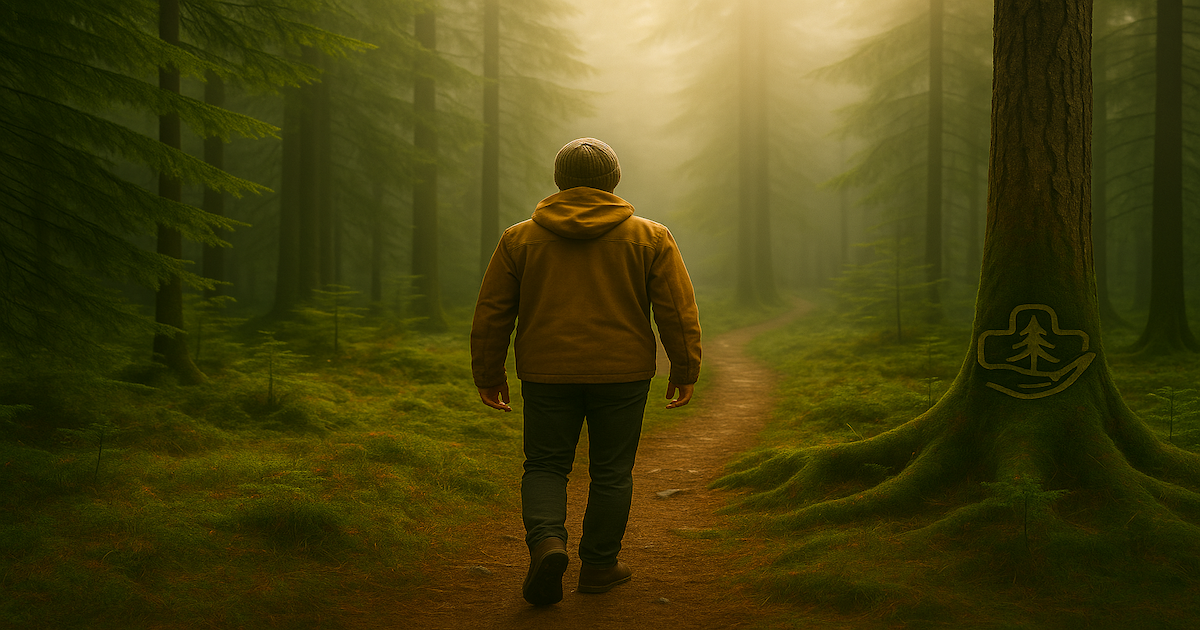
Solo forest therapy invites you to slow down, listen deeply, and rediscover the calm presence that already lives within you.
There is something profoundly healing about stepping into the forest alone, just you, the trees, and the quiet company of the living world.
Unlike a guided walk, this practice is self-led, allowing you to move intuitively and connect with nature in your own rhythm.
Whether you’re an experienced forest therapy guide or someone simply seeking stillness, a solo forest therapy walk can become a deeply nourishing ritual.
Here’s how to begin, and how to allow the forest itself to lead.
1. Preparing for Your Solo Forest Therapy Experience
Before heading out, take a few quiet minutes to set your intention. What draws you to this solo forest therapy practice today?
Maybe you’re craving peace after a busy week, seeking clarity about a decision, or simply wanting to feel more grounded. There’s no right reason, your intention is simply an invitation to presence.
Choose a location that feels safe and welcoming. It might be a nearby park, a familiar trail, or even a quiet grove of trees close to home.
What matters most is that you feel comfortable being unhurried there.
Bring only what you need, perhaps a water bottle, journal, and something soft to sit on. Leave behind distractions like headphones or your phone’s notifications.
In solo forest therapy, simplicity creates spaciousness for true connection.
2. Crossing the Threshold
When you arrive, pause before entering the forest. Feel your feet on the ground. Notice your breath.
This simple act marks your transition from the world of doing into the world of being. In guided forest therapy, this is often called “crossing the threshold.”
As you step into the forest, imagine introducing yourself to the land, not as a visitor, but as a relative. Whisper a quiet greeting. Let the forest know you’ve arrived.
From here, allow yourself to be fully guided by your senses. Listen to the subtle movements of wind through leaves. Notice the texture of bark beneath your fingertips. Smell the dampness of soil after rain.
Each sensory doorway is an invitation to presence — a reminder that the forest speaks in many languages beyond words.
3. Following Curiosity and Wonder
In solo forest therapy, you don’t need a map or a goal. Instead, let curiosity lead the way. If a shaft of light catches your eye, follow it.
If the sound of water calls, move toward it.
Wander slowly. There’s no destination, only relationship. Notice what draws your attention, a patch of moss, a bird’s song, a fallen leaf shaped like a heart.
These moments of spontaneous noticing are how the forest begins to communicate with you.
You may find yourself slowing to a near stillness, simply breathing with the trees. That’s perfect. Stillness is not emptiness; it’s communion.
4. Resting and Receiving
Find a place that feels inviting, a smooth rock, a log, or a patch of soft grass. Sit or lie down. Allow the earth to support your body.
This is the heart of solo forest therapy: the art of receiving. Let go of the need to interpret or understand. Feel the quiet companionship of the forest around you.
Notice your breath syncing with the subtle rhythm of life — a leaf trembling, an ant moving across your hand, sunlight shifting through branches.
You might take this time to journal, sketch, or simply rest with your eyes closed. Let your senses become porous. Let the forest do the talking.
5. Returning and Reflecting
When you feel ready to leave, don’t rush. Pause once more at the edge of the forest, the threshold where you began. Offer thanks in whatever way feels natural.
Reflect on what you noticed and how you feel now compared to when you arrived. Did you experience stillness? Gratitude? Connection?
Every solo forest therapy walk is unique, shaped by your state of heart and the forest’s subtle gifts.
If you keep a nature journal, write a few sentences or draw a symbol of what you received.
Over time, these small reflections become a map of your relationship with the more-than-human world.
6. Continuing the Practice
Solo forest therapy doesn’t need to be complicated or time-consuming.
Even 20 minutes of mindful wandering in a local park can restore calm and clarity. The more you practice, the easier it becomes to access that sense of grounded presence, even outside the forest.
Remember: the forest isn’t separate from you.
When you slow down, breathe, and open your senses, you’re coming home to something ancient and familiar.
So next time you feel the pull of the wild, trust it.
Step outside. Walk slowly. Listen deeply.
The forest is waiting , and it already knows your name. 🌲

2 thoughts on “How to Lead Yourself Through a Solo Forest Therapy Walk”
Comments are closed.